Friday, May 27, 2022

Fishing Buddies

The people who share our pastimes

Fishing buddies
Image credit: Steve Haefele in Salt Water Sportsman

I enjoy fishing alone, and I enjoy fishing with friends and neighbors. Alone can be quiet and peaceful and an escape from the noise of the world, while fishing with others is not only social, but practical. Fishing with buddies means more hands when we need someone at the wheel and someone on the landing net or tending an anchor. Fishing with a buddy or two is also a great opportunity to share knowledge. We talk about what bait, lure, tackle, or technique has worked well lately, and what spots have surprised us in recent days in good or bad ways. We might share what we’ve seen in the water that might affect fishing, like big schools of sand eels or bunker.


It’s great to have fishing buddies! Even when neighbors and I fish alone, we often end up comparing notes at the end of the day as we clean the boats. When my neighbors bring their boats back to the dock after a day of fishing and I’m already at my dock, I’ll walk over and offer to hand them a dock line to make things a little easier and then we’ll talk about their day.


Recently, I had the chance to expand my thinking on who "counts" as a fishing buddy.


A few days ago I did my start of season fishing gear inventory and cleanup. I dragged out all my tackleboxes and gear from my fishing shed, pulling the tackle out and cleaning the boxes and then reorganizing the tackle back into the boxes, throwing away a few old rigs that aren’t going to make another season. I cleaned up lures and hooks, replacing rusty treble hooks on topwater plugs I’ll need for spring Striped Bass. When I was done, I had a short list of fishing supplies needed, so I headed into town.


I pulled into the parking lot of the tiny neighborhood tackle shop I’ve been going to for the last 15 years, and as I entered the shop for the first time this season, I saw Tom who has run the place for the owner, his brother Pete, since the shop opened. I’ve known Tom since the shop opened. He and his shop have been a great source for fishing equipment, advice and help, and on what’s biting and where in our local waters. Over the years we’ve gotten to know each other and become friendly. Tom is really another fishing buddy, even though we’ve never actually fished together. He greets me by name with a smile, he knows what I fish for, and he knows some of my preferences on fishing equipment. I appreciate his help and advice and have many times chosen to buy rods and reels from him rather than save a few bucks at a giant chain store or an online supplier. I like my local shop to thrive and stay in business, and I appreciate that they give me the kind of personalized help a local shop provides.


Once, a few years ago, I brought in a very old Penn conventional reel that had some problems. It was very old and it wasn’t a high quality reel. I could have thrown it away, but it had some sentimental value for me. When my mom fished from time to time with my dad and me years ago, she used that reel most of the time. I had managed to keep it working for decades, but now repair was beyond me so I took it in to have Tom work on it. When he gave it back to me a week later it was working well and as part of the repair he explained that he had to replace the handle and showed me how it worked smoothly with the new one. Then he handed me something. It was the old handle on a key ring. He had welded a loop to attach it. He said, “Since it was your mom’s reel, I though you might like to keep that handle so I made a key ring for it.” I was really touched by this. I still have that key ring and keep the key to my fishing shed on it.


Anyway, back to present day. When I entered the tackle shop and saw Tom, we caught up on our winters and shot the breeze for a few and then he said, “I’m really glad you stopped in today. Tomorrow’s my last day and I’m saying goodbye to the friends I’ve made here. We are moving out of the area and starting a new life.” Tom had gotten married last fall and he and his new wife wanted to move to an area where they could afford to get a house and some land, and Long Island was not a place to do that affordably.


I wished my fishing buddy well and shook his hand telling him how I really appreciated him and that I hoped our paths would cross again. I told him I valued his help and advice, and his friendship over the years. I’d miss him and I said so. He smiled and said he’d miss my visits to the shop.


Lifelong fisherman like myself have lots of fishing buddies. They enter our lives, and sadly sometimes they depart. I first fished as a 5-year-old with my father, grandfather, and uncles. Sometimes my mother and my aunt would join us. These family members who taught me to love fishing are all gone now, but were my first fishing buddies. Now I fish often with my sons, and I’ve taught them what I know. These days I also fish with my neighbors and with friends from my school days. All of these people have been my fishing buddies.


Thanks to all my fishing buddies, past, present and future. You make my time spent fishing that much better!


Thanks for reading! A blog works best with active participation. If you enjoy this blog, leave a comment, tell others about it, and share a link to it on your favorite social network. More readers will drive more discussion.


Sunday, February 27, 2022

My New Ride

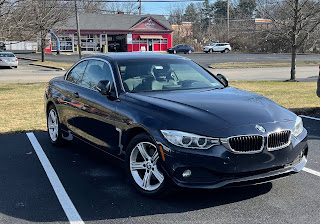
Back in March 2015 I bought a new BMW 428 hard top convertible, making it the 10th car I’d owned in my life, but just the 4th new car. The dark blue BMW was beautiful to look at, and the power, ride, and features quickly made this car my favorite, even surpassing the fond memories I had of my first ever car - a 1972 Chevy Monte Carlo. Add to that the thrill of the automatic hard-top motion looking like something out of a Transformers movie, and I became very attached to this car. 

BMW 428 cxi

BMW 428 cxi


It may sound strange to some, but I name my cars, just as I name my boats and my houses. I called my BMW 428 “Serenity” and enjoyed driving her year-round but especially in the summer with the top down and my favorite music or podcasts playing on the stereo, wind in my hair.


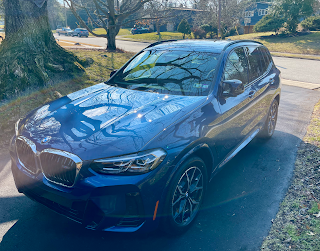
Late in 2021, I decided that the time was coming to trade the car in before too many miles racked up on the odometer and before anything major went wrong. My goal was to make a change by or before 7 years with the car. I considered getting the latest version of the same car, but design changes made the BMW 400-series convertibles less attractive to me. Also, I had begun to think about getting a small SUV as my next car in order to haul music gear and beach chairs other things that are parts of my life. I also wanted a car that I could use to tow small watercraft. I looked at a range of brands and models and had hoped to find a luxury hybrid SUV with the right features in the right size at the right price point, but in the end my choice was the BMW X3 M40i which was everything I wanted except for hybrid. The larger X5 comes in a plug-in hybrid model but it’s just too large a vehicle for me. Other brands have some great models that I considered, but in the end my mind was made up.


I placed an order for a BMW X3 M40i configured with colors and trims and features I wanted and picked it up early in February 2022. In the first week with the car, I didn’t get to drive it much and as much as I was loving it, I had some funny moments of not knowing how some things worked. I couldn’t figure out how to move the moon roof cover and I misunderstood a speed warning setting resulting in an almost constant speed warning. The heads-up display was not in the perfect position and though I adjusted it, it still wasn’t quite right. Slowly, I read the manual and tried things and got to know the vehicle, and a recent 6 hour round-trip drive helped me to really get to know my new car. I’m really enjoying it a lot now and will no doubt learn more in the coming months. I look forward to several years with this wonderful small SUV, and as I get to know her better, I’ll probably give her a name.


BMW X3 M40i

BMW X3 M40i


Thanks for reading! A blog works best with active participation. If you enjoy this blog, leave a comment, tell others about it, and share a link to it on your favorite social network. More readers will drive more discussion.

Sunday, May 30, 2021

My First Boat

Simple beginnings


At around this time every year I write about getting my boats into the water and preparing for another boating and fishing season. I watch my neighbors getting their boats ready and, after a quick “how’s the family?”, we talk about boating and fishing in the summer to come. This year instead of looking forward I’ll look way, way back. My boats today are modern fiberglass fishing machines, fun and comfortable to ride in with cushioned seating, cup holders, and Bluetooth radios. My first boat, though, was very different.


When I was 11 years old, my family spent a few summer weeks in a fishing village that was in the process of changing into a vacation community. I spent my days climbing onto little boats with neighborhood boys, getting to know the local waters and learning the wonders of little engines which we started with a pull string and steered “tiller style” with a handle on the engine while sitting at the stern. We cruised the bays, beached the boats to explore little islands, and best of all, we went fishing. I had learned to fish at my father’s side when I was just 5 and loved it. Now at 11, I also had the “boating bug.”


My father was happy about my newly found love for boats and he and I got an empty cigar box and started a boating fund that fall. Every spare nickel was tossed into the box and about once a week I counted it. We didn’t have a lot of money in those days and so it built very slowly. By the spring almost 2 years later in about 1973 we had saved just over $300 (please don’t laugh!) and were looking for a first boat we could afford when my father stumbled across an old wooden boat that he decided was perfect for us. We bought it for $100, leaving us some money to buy equipment and also to pay for some help with hauling it out, scraping the barnacles, filling in spots with wood filler as needed, and painting it. We were willing to do the work, but we were still learning how. 

similar vintage boat


I have no pictures of this boat, but I can paint you a picture in words. It was a very old wooden v-hull boat, about 18’ long, and painted white. There was a flat windshield that, like the rest of the boat, looked cobbled together. I think this flat windshield with three window panes may have been converted from a porch window. Forward of the windshield was a small compartment for the anchor and life jackets, and aft of the windshield was just an open boat. The deck or floor of the boat was wooden decking sections that lifted out to reach the wooden bottom of the boat. 


I remember that there was always a little water in the bottom of this boat as if something was always slowly leaking. In those days, it was common to bail a boat out with a small bucket or a used Clorox bottle with the bottom cut off, thus making a scoop with a handle. A few years later, we got a kind of bilge pump that looked like a bicycle pump. It was meant to be placed on the deck of the boat and the handle at the top pumped up and down so that the water would be pumped out through the hose which was placed over the side. That was a luxury! Today, by comparison, both my boats have electric bilge pumps with a float sensor, so they turn on and off on their own, and neither boat leaks at all unless something is very wrong. The pumps are mostly to handle rainwater and wave splash.


The steering system of this first old boat of ours was a set of cables and pullies rigged to a steering wheel below that awkward flat window windshield. The cable looped around the shaft of the steering wheel and when you turned in either direction it caused the cables and pullies to pull on metal brackets mounted on each side of the engine, causing the engine, and thus the boat to turn. The steering wheel was a comically small version of a ships wheel with spoked handholds. 


Everything about this boat screamed ‘jalopy’ but we didn’t care. We had a boat of our own and if we kept up with the maintenance and saved every penny to pay for parts and labor, we could go fishing whenever we wanted to. And we did! We fished from April to November those first few years. My father was an expert fisherman, and he knew how to read the waters. In those days we had paper charts and no electronics at all. As a former Navy man, my dad had a knack for finding his way back to favorite fishing spots by triangulating landmarks on shore with buoy locations. It must have worked well because we regularly caught more fish than all the boats around us.


The boat lasted us only a few years as the wood filler couldn’t keep up with the cracks and holes. We eventually had to junk the boat, which was sad, but replaced her with a fiberglass boat of similar size and more modern affordances. Over the course of more than 45 years, I’ve had no fewer than 9 boats, but that simple and ugly wooden boat was the first. This year as the boating and fishing season gets underway, I remember how it all started.


Thanks for reading! A blog works best with active participation. If you enjoy this blog, leave a comment, tell others about it, and share a link to it on your favorite social network. More readers will drive more discussion.


Sunday, April 11, 2021

10 Years of RapidGroove


10 years ago, in April 2011, I started the RapidGroove blog with a post called I think that bird said beep. I followed that a few days later with My Doctor Just "Friended" My Pancreas.

Writing a blog is a bit of a conceit. You have to believe that you have something to say and that other people might care. Twitter gives us a few hundred characters to say something, Facebook a little more. Blogs give us more space to work with and I have appreciated that. Looking back now on 240+ posts and almost 84,000 views, I'm still enjoying writing the blog.


I decided to start blogging back in 2011 to exercise my "writing muscles" and to try to get better through practice. Writing is one of those things that I believe can be valuable in many settings. I also think that when we practice writing, it helps us to appreciate the writing skills of others. That is to say, I sometimes read an article that I think is well constructed and admire the authors work and think about how they achieved it and what I can learn from it. I'm not sure I would read in quite that way if I didn't write as often as I do.

In my work as an IT Leader at three different universities over 3+ decades I wrote often, and today in my work as an Executive Partner at Gartner, I write even more.

In the RapidGroove blog, I have written about fishing, cooking, technology, and other things. I often wanted to write about other topics that interested me and on which I had an opinion, but decided that the topic was controversial in some way and that writing about it in a public way didn't serve my purposes well. For these topics, I'll gladly share a pitcher of beer or bottle of wine with friends and have friendly arguments in person! For RapidGroove, I always tried to choose topics that were interesting to many and offensive to almost nobody.

After 10 years, I don't know whether I'll continue to write in RapidGroove as often. Over the years I tried to write at least once a month, and often I wrote much more often than that. Going forward, I may just write when the mood strikes. I do have a very large writing project in mind apart from blogs, and I look forward to taking that up when I retire.

If you've been a reader of RapidGroove during these last 10 years, and especially if you commented here or in social media or in person, thank you. Your choice to engage in the discussion helped to make this more fun and interesting.

Thanks for being part of this 10 year journey!

Links:

Thanks for reading! A blog works best with active participation. If you enjoy this blog, leave a comment, tell others about it, and share a link to it on your favorite social network. More readers will drive more discussion.

Sunday, March 14, 2021

Will COVID-19 Cause Airports to Change Again?

Standing in line and showing your papers 

After the horrific events of September 11th, 2001, and some subsequent terrorist attempts involving passenger air travel, we all got accustomed to real changes in the experience at the airport. Long TSA lines, taking off shoes, throwing away our water bottles at the check point, travelling with tiny containers of toiletries, plus a trip through the X-Ray machine for our luggage. I’m wondering whether we are on the eve of another set of changes at airports.


COVID-19 documents
Photo credit industryweek.com

One of the many Coronavirus-inspired discussions these days surrounds proof of vaccination. As the numbers of people vaccinated goes up, some still refuse vaccination and others just haven’t gotten the opportunity yet. It seems to me that the airports, and even the airlines themselves, are in uncharted territory as more people look to get back to air travel.


In order to preserve safe conditions, will we be asked to carry “vaccine passports” as proof of vaccination in order to travel to and enter some locations. Would this be one more document to show at the TSA checkpoint, or perhaps at some other airport check point? What are the implications for international travel? Today, upon entering a country from international travel, we go through customs to review what we might be bringing into the country from elsewhere. How might this change? It’s not hard to imagine something like vaccine passport checks as part of the process, given that different countries may be at different levels of vaccination and have different rules regarding travel. 


Beyond documents, will rapid testing play some part? If, as we all hope, vaccinations worldwide help to make COVID-19 rare or even "background noise" soon, maybe there’s no role for testing in airports. But what if some of the COVID-19 variants make for uncertainty over the next year or more about vaccination efficacy? Would rapid testing at airports, perhaps with short term quarantine areas, need to be considered for at least some arriving passengers depending on the locations they have visited?


We didn’t imagine the airport experience changing so drastically before September 11th, 2001. Maybe we should imagine it now.


Do you think COVID-19 may have any significant impact on the travel experience or do we go back to the February 2020 notion of “normal?” What if anything do you expect to change? Leave a comment and let us know.


Thanks for reading! A blog works best with active participation. If you enjoy this blog, leave a comment, tell others about it, and share a link to it on your favorite social network. More readers will drive more discussion.


Friday, February 26, 2021

In Praise of Fishing Magazines

Over the last 10 or so years, most of my reading has shifted format. I find that I don’t hold paper in my hands in order to read the printed word very often at all anymore.

I do all of my work-related reading on my laptop, my large monitor, or on an iPad. I read for fun on the iPad, and I listen to books on Audible on my phone. I used to read physical newspapers, with all the associated folding trickery, sometimes for hours at a time. Now I read “newspaper” articles for a minute at a time on my phone when I wake up, and occasionally during the day when the alerts on my phone are sufficiently interesting. I subscribe to the New York Times but only the digital edition. I still read some of the things that arrive at my house by US Mail in the old school ways, though I recycle a lot more than I actually read. As I think about it, I read very little today in the formats and ways that I did just 10 years ago.


My one big exception is fishing magazines. I subscribe to a few fishing magazines and one boating magazine and I still get them delivered in paper form. I still pick them up in my hands, without any electronics involved, and read them that way. More than that, I keep them around for years. I often pick up old issues and read through them again.


When I first get a fishing magazine, I leaf through it slowly and take note of the article titles that are of interest to me. It won’t be all of them. The ones that catch my eye deal with the kinds of fishing that I do, and in the regions that I like to fish or hope to some day fish. Sometimes there are articles about techniques that interest me, such as kite fishing for sailfish, or trolling for tuna and wahoo, or articles about fishing rods and reels and tackle that I use or want to try. I might read these right away or remember them for later. I skip over other techniques that are less interesting for me such as fly-fishing in fresh water. I also may read the reviews of new boats and boating equipment, and I look over the ads for equipment ideas.


When I come back to one of my fishing or boating magazines, whether a week later or years later, I’m already familiar with it. I can leaf through it again and be reminded of the things that I noticed the first time. I might read an article about fishing halfway around the world, or one that caught my eye on drifting techniques or rigs for Striped Bass close to home. It doesn’t matter if the article is 3 years old, it can still inform my fishing.


Unlike news articles which are timely, and unlike most books which I generally read once from start to finish, these magazines are things I read small parts of over longer periods of time. The photos and headlines and ads fuel my fishing dreams.


My fishing and boating magazines are my favorite beach and deck reading and I keep favorite issues around for years. They really are the last big holdout in my old school reading of the printed word on paper.


Do you read much in dead-tree format? Leave a comment and let us all know.


Thanks for reading! A blog works best with active participation. If you enjoy this blog, leave a comment, tell others about it, and share a link to it on your favorite social network. More readers will drive more discussion.


Saturday, January 30, 2021

Working at Home During the Pandemic

This is the 5th time I’ll be blogging on topics that are related to the pandemic. Given the profound impact it’s had on our lives, that probably shouldn’t be a surprise to anyone. 

About 6 months before the pandemic really took hold in the US, and well before it had serious impact on how we work, I changed jobs. My new job involved about 75% work from home and about 25% travel. The company I work for has offices around the United States, some of which have large numbers of office workers, but my job wasn’t assigned to an office under normal circumstances. By March of 2020, as things were changing radically for many workers, I was very lucky in that I kept my job and could continue to work. More than that, the shift to 100% work from home for me was a fairly minor adjustment.

Working at home


Those who have been working from home for years probably have many “pro tips” that make them successful in working from home. I’ve been learning along the way.


Space: Some things are obvious, like having a dedicated space that’s laid out well and ideally is separated from the distractions taking place around the house. I spend a lot of my day on camera, so my space has to be well-lit and tidy, too.


Time, part 1: Some things changed immediately. In the past I had a 1 hour commute each way, so I gained back 2 hours a day. Even if I spend one of those “found hours” on work, getting even more done, I still get back one hour a day for myself and that has been great. As the family cook, I often use that time to get dinner going while listening to audio books or podcasts, which is therapeutic for me. Other times I use 5 minutes of that hour to place an online food order and then watch television or play piano.


Time, part 2: Managing time became a little different. One of the first things I began to learn was exactly how long mundane things in my life take. If I have 3 minutes before my next meeting, do I have time to run to the kitchen, get a cup of coffee, and be back and on camera before my meeting? Yes, easily. I don’t even have to run. Within the first few weeks I learned how much time I needed to make and eat lunch, or visit the restroom, or grab a sport coat for the next call. As it turns out, a few minutes are all that are needed for lots of things when they are within the limited confines of your home.


Lunch: Since I’m not out and about, I don’t buy my lunch at restaurants or delis. I have to plan ahead a bit more and have food in the house, which has been good for several reasons; I can plan for healthier lunches, and I can save some money. But the best revelation about lunch didn’t occur to me until several months in to working-from-home. For the last 35+ years I chose my lunch in ways so as not to impact my breath. Now, though, if I choose to have leftovers from last night’s garlic-laden dinner, or if I want a bunch of raw onions on a sandwich, I won’t offend my boss or my clients in afternoon meetings. This is surprisingly freeing! Of course, I still need to be considerate of others in the house.


Dress Code: The usual joke is that while on camera professionals must dress the part with shirt and jacket but don’t necessarily need pants. I do, indeed, wear pants. But while in my last job my pants were usually part of a suit, my pants these days are often jeans, or the warm-up pants I used to wear to the gym while my top half is generally neat business casual. The thing I generally don’t wear is shoes!


Clothing budget: Related to the above, there was a big change to my spend on clothing. When I wore suits, there were dry cleaning bills and the occasional additions of dress shirts or ties, and at least once a year a new suit. That stuff added up! All of that past spend is now savings for me (which I’ll probably blow all at once on a piece of music gear or a fishing trip).


The pandemic has been a terrible chapter in our lives, with many of us suffering losses of loved ones or health impacts or economic impacts. I feel very lucky so far to be managing well and will remain committed to masking, washing, and social distancing. And getting vaccinated when I am able. I remain hopeful that the second half of 2021 will look better than the present or recent past has been, with chances to visit restaurants and theaters and gather together, but will continue to adjust my life in the meantime.


How are you managing? What are your tips and tricks? Leave a comment and let us all know.


Thanks for reading! A blog works best with active participation. If you enjoy this blog, leave a comment, and share it on your favorite social network. More readers will drive more discussion.

Monday, December 28, 2020

Winter by the Water


I’m lucky to have a small beach house that I use as much as possible from May to November as home base for fishing and beaching. From time to time I visit in the off season just to maintain the place. We have to chase small critters (racoons, squirrels, rodents, even bees) away from time to time and deal with seasonal stuff and small repairs.


I had a short but fun visit late this month to take care of a few things. I managed my schedule so that I drove or walked near the water often as I did my errands. The weather was mild, the skies were clear, and the water looked great – though I’m sure it was very cold.


At this time of year all of the boats are out of the water and either stored for the winter at marinas or up on the lawns and driveways of my neighbors. We “shrink wrap” our boats in plastic to keep them clean and dry until spring when we can tear the shrink wrap off and start preparing for a new season. These first two pictures in white shrink wrap are my boats, on the driveway and lawn, and the two in blue shrink wrap are neighbors’ boats. 


The area was really quiet for these two days. None of my immediate neighbors were around, though I did see plenty of people out for walks when I was out for walks and bike rides of my own. During the season I probably see hundreds of boats every day. This time as I looked out over the water, I saw only two or three boats the entire time. The birds and fish have the waters to themselves. My favorite marina and restaurant was closed too, though I did get a great lobster roll and chowder, and some smoked fish to take home, at one of my favorite local markets.


Here are a few photos of what the beach is like in the winter – a beautiful reminder of what brings me back every spring. 


Thanks for reading! A blog works best with active participation. If you enjoy this blog, leave a comment, and share it on your favorite social network. More readers will drive more discussion.

Sunday, November 29, 2020

COVID-19 is the Common Enemy

Defeat the virus now, argue with each other later 


Let’s start off by seeing if we can agree that responding to COVID-19, the infectious disease caused by the coronavirus, really shouldn’t be anything we argue about, and it certainly shouldn’t be a political issue. Everyone I know, of every political persuasion, believes that the death of innocent people is a tragedy. Everyone wants people to stay healthy. Everyone I know also wants the economy to do well for ourselves and our friends and family. Nobody wants pandemic death to devastate families, and nobody wants the pandemic to crush the economy and the livelihood of hard-working people. We all want to be back to (something close to) normal as soon as we can, able to gather together, able to go to a restaurant, a concert, a school. Can we agree that those are fair statements? 


The fight is against the coronavirus, not against each other. We’re still in the middle of this fight, and we still need to cooperate and to fight together against the virus rather than against each other.


There is good news and there is bad news. The good news is that thanks to the amazing work of the scientific community, multiple highly effective vaccines are on their way. It has been inspiring to see how multiple teams worked incredibly fast in the interests of public health. Help is on the way. 


The bad news is that the coronavirus continues to spread very quickly right now, and that new cases, hospitalizations, and deaths continue to rapidly rise. With more holiday season gatherings taking place in indoor settings, there is a serious risk that the massive spike continues through December and January. The death toll is already well more than a quarter million American lives, rivaling the death toll of our most devastating wars and we are far from done. More Americans have died from COVID-19 than died in World War I, the Korean War, and the Vietnam War combined. Within a few weeks, the death toll of COVID-19 will surpass the death toll of World War II.


Now let’s get back to the part where we come together and fight effectively against the virus. If we can show some discipline now and for a few more months, we can limit the impacts.


With a good vaccine distribution plan and broad acceptance and willingness to be vaccinated, we can probably be in a much better place by mid 2021. We have to be realistic about the timeline, of course. It will probably take 5 or 6 months to get from where we are now to the point where we have achieved herd immunity through vaccines and natural immunity from those who have been infected and have recovered. So what do we do now?


I’m not suggesting shutdowns and giving up on the economy as part of fighting the coronavirus. We need a healthy economy, and the best thing for the economy is public confidence. People are showing that they are unlikely to spend and to hire in the middle of so much uncertainty. There’s a good case to be made that the best thing for public confidence is managing the impacts of the coronavirus now and defeating it in 2021 when the vaccines are broadly available.


I’m certainly not a public health expert, but I try to take the advice of those who are. There are plenty of well-credentialed researchers and public servants who have been studying viruses and advising governments on public health for decades, and they are broadly in agreement. Among the most visible of these are Dr. Deborah Birx, Dr. Anthony Fauci, Dr. Scott Gottlieb, and Dr. Robert Redfield. They have been studying the spread and their advice is evolving as we learn.


Over these last 9 months, the experts have learned a lot. We understand the spread better now, and what measures help. Given the state of things today, we probably don’t have to “shut down everything” but instead we can be more surgical by restricting certain activities and certain business types and we can do it in the regions that we can see are most at risk by watching the trends in positive tests and hospitalizations. We can continue to look closely at effective practices, and yes, temporary restrictions if need be, for bars and restaurants while we try hard to keep schools open.


What we hear from the public health experts is that there are some straightforward approaches to limiting spread. Let’s all wear masks when outside our homes, practice social distancing, avoid crowds and family gatherings. When we have to be together, outdoors is better than indoors. When we have to be indoors, opening windows and improving ventilation can help. 


Again, everyone I know wants people to be healthy and wants the economy to do well, and nobody wants pandemic death to devastate families and crush the economy. The American people have always stepped up when times were tough. Let’s do it again. Let’s be strong and do the things within our power to get us through. The coronavirus is the enemy. All of us are on the same team and it is within our power to keep each other safe and to get through this together.


Links:


Thanks for reading! A blog works best with active participation. If you enjoy this blog, leave a comment, and share it on your favorite social network. More readers will drive more discussion.


Monday, October 26, 2020

Halloween at Home

Since March, most of us have been at home a lot more than in the past. We are working from home, 'going to school' from home, even doing doctor's visits from home. We eat at home more often, not going to restaurants, and when we don't want to cook, we stay home and have food sent.

And now, we're looking at a Halloween at home. Some kids will have a much more limited Halloween trick or treating plan, visiting a few trusted houses as carefully as possible. Some may stay home and skip trick or treating entirely. Most young adults who might have gone out to a costume party for Halloween may instead stay home.

Okay, we're staying home more. But why would that mean we cannot have Halloween? Here's Dr. Deke's Halloween prescription...

  1. Get a costume
  2. Buy some candy
  3. Have Halloween at home

I have dressed up for Halloween many times as an adult. When my kids were young, my wife stayed at home to hand out candy. She wore a costume. I dressed up as Darth Vader or Captain Kirk, or a pirate and took the kids out trick or treating. At many of the houses, the adults handing out candy were in costumes. 

If we work from home, attend school from home, see our doctor from home, do our grocery shopping from home, let's just have our Halloween at home. Dress up, get on some video calls with your friends and neighbors and show off your costumes while eating some of that candy. You can (safely, carefully) drop off a bag of candy at your neighbors house. They can do the same at your house. We can have a fun, if slightly different Halloween. We just have to allow ourselves to do it.

Who's in?

Thanks for reading! A blog works best with active participation. If you enjoy this blog, leave a comment, and share it on your favorite social network. More readers will drive more discussion.

Saturday, September 12, 2020

Labor Day

2020 is an unusual year, but some things are familiar


Labor Day weekend in the US is about a week in the past as I write this. Labor Day isn’t really the end of summer, which officially comes a few weeks later, but it’s a clear turning point. Summer is ending soon and fall is starting to push in. Students are heading back to school (though in very unusual ways this year), and mornings and evenings are noticeably cooler.


At my beach house we can see the changes in the surrounding wildlife. Over Labor Day weekend I was in my yard doing some work on fishing tackle when I saw large birds swimming toward me down the waterway. In the summer, it would have been swans but now it was Canadian Geese. In fact, from that point on they seemed to be all around, including flying south in V formation overhead. 

Canadian Goose


I also started seeing Monarch Butterflies, a sure sign of fall. We see lots of migrating Monarchs at the beach and even over the water as the fall starts.

Monarch Butterfly


The fish are changing with the season, too. We can see this in the water where the species and size changes are noticeable, and in the tackle shop where the baits and rigs for fall fish start to show up. The pods of bunker are larger, and they will soon be chased by Striped Bass moving into the area. The bottom fishing is seeing more and bigger Black Sea Bass as the water gets a little colder and clearer.


Black Sea Bass

At the farm market, the size and mix of fruit and vegetables has started to change. There are fewer strawberries, but larger corn, and more apples. And when pumpkins show up it’s really clear that fall is coming.


The night sky is changing, too. We always see more stars at our beach house in the fall, as the humidity drops. We have been enjoying finding constellations and planets, assisted by smartphone apps, while sitting around the evening fire.


Over the Labor Day weekend I watched as neighbors put away some of their summer toys for the season, including wave runners and standup paddle boards, while leaving bigger fishing boats in for a few weeks longer. Some are even beginning to close up their summer houses but my plan will be to leave the “summer house” open all winter this year as a getaway. COVID-19 isn't done with us yet and the availability of a second home to stay locked away will provide a welcome change from time to time.


I'm always a little sad when Labor Day comes, but I'll look forward to a pleasant fall and I'll start counting the months until summer returns.


Thanks for reading! A blog works best with active participation. If you enjoy this blog, leave a comment, and share it on your favorite social network. More readers will drive more discussion.


Sunday, August 30, 2020

Ideas, Creativity and Prior Art

Where do inventions come from? What’s at the root of innovation and creativity? Does it involve lightning bolts and divine inspiration? Do fully formed ideas pop into the heads of creative people? 


Erector Set

Probably, sometimes. My own experience has been less dramatic, usually involving incremental improvements and new ideas for tomorrow inspired by the things that have been successfully built for today. Thinking about this subject, a story from more than 50 years ago popped into my head.


When I was about 6 years old, my parents got me an erector set. Many people today might not be familiar with these, but they were once very popular. The set was a box full of little metal parts machined with holes the right size for a set of included bolts. Combined with the wheels and pullies and the nuts and washers, the erector set made it possible to build objects like buildings, windmills, and even vehicles like cars and helicopters.


I remember building simple shapes at first and, as a kid living close to New York City, I built little “skyscrapers.” The wheels, though, are what had me interested. I soon figured out how to build a basic car using axles and wheels attached to some basic shapes. With a few tries, the shapes started to get sportier and I soon had something like a racing car that really rolled smoothly. This was great! 


When I found out that it was possible to add a battery powered motor to the erector set, I was thrilled. I convinced my parents to let me send away to the company and buy the motor. I used some birthday money and they wrote the check and addressed the envelope. Several weeks later (we didn’t have Amazon Prime in 1969), my motor arrived. It was a small yellow motor that could fit in the palm of my hand. It had a 9V battery connector and the battery would drive a rotational drive shaft that could, when controlled with a 3-position switch, spin forward or reverse or that could be set in neutral, not spinning.


In my first attempt, I secured the motor to a car I had already built, put it on the floor, and was disappointed when the car didn’t drive away. I had done nothing to transfer energy from motor to car. As my 6-year-old self pondered this, I looked at a picture in the materials that came with the set and saw a motor connected to a windmill and immediately understood the idea. I needed to use the motor to turn another piece of hardware that could drive a belt (a rubber band) that could attach to another piece of hardware attached to the wheel. This was the concept being used on the windmill and I could translate the idea to a car. This was exciting! Within minutes I had a motorized car moving across the floor, having learned how to solve my challenge by studying a similar example and learning from it.


Echoes of my experience came up often over the years. I watched as good programmers studied the code of others, and adapted ideas originally used to solve one problem in order to solve a different one. Good musicians talked about their influences, having listened to the way a favorite guitar player or singer chose to play through the music and then integrating some of those choices into their own style.


The biggest example of all may be in the science disciplines. Science values prior art so much that a big part of the way that peer-reviewed journal papers are assessed is by looking at the quality and quantity of relevant references, as these are a sign that the existing body of knowledge has been considered in communicating something new.


There is a difference between on the one hand inspiration from prior art, and referencing the strong works of others, and on the other hand theft and plagiarism. Knowing the difference is very important, but failing to leverage and respect what went before is like intentionally leaving much of your toolkit at home every day.


There’s no one answer to the questions I asked at the top, of course, but in my experience the concept of prior art looms large in a very broad range of creative pursuits.


How do you think about creativity, innovation, and associated concepts? How have you created in your own life? Please leave a comment and let us know.


Thanks for reading! A blog works best with active participation. If you enjoy this blog, leave a comment, and share it on your favorite social network. More readers will drive more discussion.


Saturday, July 25, 2020

Playing Music Together – Separately


The age of the COVID-19 pandemic has changed so much about how we live our lives. Every one of us can describe the impact on our employment, ability to see family and friends, to travel, and even to get groceries. Sadly, some of us have been sick or have been taking care of those who are, and some have lost loved ones. We are living through a time unlike any in living memory.

One smaller but important impact of the pandemic is the loss of live entertainment. Broadway has gone dark, major musical acts have canceled their tours, and little hometown rock and roll bands like mine, The Lava Rocks, have abruptly halted gigging in the local bars.

The Lava Rocks are a classic rock cover band who started gigging in 2019 and by early 2020 had started to play steadily once or twice a month. Our March 7th gig was our last for a while, though, and we’ve missed a number of planned dates since. We have shows on our calendar through the rest of 2020 but don’t hold high hopes of playing many or even any of them under the circumstances.

In order to remain connected with each other, and to continue to have a musical outlet, we have done what many musicians have done - we’ve turned to the web. We looked back at some rough video we had of recent shows in the local bars (The Mermaid Inn, The Grape Room, The Red Stallion) and picked out some that suited our purposes, which means the audio and video had to show a complete song, be focused reasonably on the stage, with the stage reasonably well lit, and with reasonable quality audio. It was surprising how much of the video these basic criteria eliminated! But with a few clips picked out, we produced some “web shows” in which we made a few introductory remarks on camera and showed these videos. They can be found on our web site at the CONCERTS link (https://www.TheLavaRocks.com/concert/). We hope you’ll go check them out if you haven’t already seen them.

After releasing web shows on April 18th and May 16th, which were great fun for us to put together, we found that we’d used up most of the audio/video material that meets the criteria above, so we decided we needed to begin to create new content. 

The obvious approach turns out to be completely unworkable. People everywhere are spending lots of time on video collaboration applications like Zoom, so it seems like playing music together, separately, should be doable by joining a Zoom session and just playing as though all are in the same physical room. As anyone who has tried to sing Happy Birthday in a crowd assembled on Zoom has quickly found out, this doesn’t work well at all! The reason is that small variations in delay from each participating camera to the Zoom servers and then back to the other participants (an effect known as “jitter” to network engineers) makes it impossible to properly synchronize.

The Lava Rocks spent some time considering a few popular apps for recording piecemeal, one at a time, and handing off to the next person. None were quite what we wanted, and some made it hard for us to maintain complete control over the content. In the end we decided that a very simple approach might work best for us, using home recording computer applications such as Garage Band and Pro Tools. 

We begin by deciding on the tempo of the piece we want to record. Sometimes we lock this tempo in to match the original album recording of the song, sometimes we intentionally choose something a little slower or faster for our purposes. We then create a “click track” in the recording application, which is a simple click or drum beat at the tempo we selected. We export that simple track as a very basic quality audio file (usually an MP3) and distribute to all band members. The band members then listen to that click track on headphones while recording their part(s) on their computer or even their smartphone, trying to get the best quality audio they can with the least noise. They capture that as a sound file and send that sound file back to the band member engineering the song, who drops it into Pro Tools or Garage Band and aligns them. The tempo will already match because of the click track. The click track is then thrown away and the levels are adjusted for each track. A rough mix of the music is done and exported as a sound file, allowing the vocalist(s) to record their parts while listening to the audio in headphones. Now with the vocals, a re-mix of all tracks is done along with the addition of a little reverb to get a final product. This whole process takes about 2 weeks and about 3 hours of time on the part of the band member engineering the final product.

Once we have a complete and final song recording, we can release the audio. We know that for the web, though, a video is also desirable. With that in mind, we are recording video clips of us recording the audio at home and using the combined audio and video to create something like a music video.

This whole process takes a lot of work, and we are learning as we go. We hope to share some of our work product with all of you in the coming weeks. We hope you’ll give our songs and video a look and listen, and invite you to let us know what you think of the results. In the end, though, we’ve already achieved something really important to us – we’ve stayed connected as a band and continued to play music together, separately.

Thanks for reading! A blog works best with active participation. If you enjoy this blog, leave a comment, and share it on your favorite social network. More readers will drive more discussion.